
🧠 Introduction to Artificial Intelligence – Meaning, Evolution, and Impact on Modern Life
Artificial Intelligence (AI) is no longer just a futuristic dream—it’s the living heartbeat of our modern world. From unlocking your phone with face recognition to chatting with virtual assistants, AI silently supports our daily lives. In this first part of our Career Craft India AI Series, we explore what AI truly means, how it works, its history, importance, applications, benefits, and the path it’s paving for our future.
1️⃣ Part 1: Overview – What is Artificial Intelligence?
Artificial Intelligence (AI) refers to the ability of machines to perform tasks that normally require human intelligence—like understanding language, learning from data, solving problems, and making decisions.
In simple words, AI allows computers to think, learn, and act just like humans, but often faster and more accurately.
Imagine teaching a child to identify animals through pictures. Similarly, in AI, we “train” a computer by feeding it thousands of images of cats and dogs until it learns to recognize them on its own. That’s the beauty of AI—it learns from experience.
At its core, AI is about creating smart systems that can sense, reason, learn, and interact. It combines computer science, mathematics, psychology, and linguistics to make machines intelligent.
2️⃣ Part 2: How AI Works – The Core Idea Behind Machines that Think
AI works on a simple yet powerful idea: machines can learn from data. Instead of being programmed with exact instructions, AI uses algorithms that allow computers to “learn patterns” from examples.
The process involves three main steps:
- Data Input: AI systems collect information from sensors, text, or images.
- Learning: Algorithms study the data to find patterns or make predictions.
- Decision Making: The machine applies its learning to perform actions or answer questions.
For example, an AI-based email system learns what spam looks like and automatically filters it out. This shows how AI “thinks” through experience rather than rules.
This self-learning capability makes AI systems more adaptive and powerful with time.
3️⃣ Part 3: History and Evolution of AI
The story of AI began much earlier than most people think. Ancient philosophers dreamed of mechanical beings that could reason like humans.
But the real journey started in the 1950s, when computer scientists like Alan Turing and John McCarthy laid the foundation of AI as a scientific field.
- 1950: Alan Turing proposed the Turing Test—a way to measure if a machine can think like a human.
- 1956: John McCarthy coined the term Artificial Intelligence at Dartmouth College.
- 1970s–1980s: The rise of Expert Systems that mimicked human decision-making.
- 2000s–2020s: The explosion of Machine Learning and Deep Learning technologies revolutionized how AI performs today.
Today, AI is not just an academic idea—it’s embedded in everything from smartphones to satellites.
4️⃣ Part 4: Major Milestones and Key Figures in AI Development
Artificial Intelligence has advanced through decades of innovation and determination.
Some of the key contributors include:
- Alan Turing: Father of theoretical AI and the concept of machine intelligence.
- John McCarthy: Creator of the term Artificial Intelligence.
- Marvin Minsky: Pioneer of cognitive simulation.
- Geoffrey Hinton: Leader in Deep Learning and Neural Networks.
Milestones include IBM’s Deep Blue defeating chess champion Garry Kasparov (1997), Google’s AlphaGo beating world Go champion (2016), and ChatGPT bringing conversational AI to billions (2022 onwards). Each milestone made AI more human-like and accessible.
5️⃣ Part 5: Importance and Role of AI in Modern Life
AI has become a silent partner in human progress. It powers the apps we use, the cars we drive, and even the healthcare we receive.
- In Education: AI supports personalized learning and smart tutoring systems.
- In Healthcare: It helps detect diseases early and improves patient care.
- In Business: AI enhances decision-making and automates routine tasks.
- In Daily Life: From Netflix recommendations to voice assistants like Alexa, AI shapes comfort and convenience.
AI’s impact extends beyond technology—it changes how we live, work, and interact, making our world smarter and more connected than ever before.
6️⃣ Part 6: Real-Life Applications of AI in Different Sectors
The applications of AI are vast and growing every day:
- Healthcare: Diagnosis, surgery assistance, and drug discovery.
- Banking: Fraud detection and personalized financial advice.
- Transportation: Self-driving vehicles and smart traffic systems.
- Education: Adaptive learning platforms and virtual classrooms.
- Entertainment: Film recommendations, music generation, and gaming AI.
- Agriculture: Smart irrigation, crop monitoring, and yield prediction.
AI’s versatility makes it a key technology for every industry, ensuring better efficiency and accuracy.
7️⃣ Part 7: Benefits and Challenges of AI
Like every technology, AI has both bright and dark sides.
Benefits
- Increases productivity and accuracy.
- Saves time through automation.
- Improves decision-making using data analysis.
- Creates new job roles in AI, data science, and robotics.
Challenges
- Job loss due to automation.
- Data privacy and ethical issues.
- Risk of bias in AI algorithms.
- Over-dependence on machines.
The challenge is not to stop AI, but to use it responsibly, ensuring technology serves humanity rather than replacing it.
8️⃣ Part 8: Future Scope and Final Thought
The future of Artificial Intelligence looks bright and limitless. Emerging trends like Generative AI, Quantum Computing, and Autonomous Robots are shaping a world we could only imagine before. AI will soon personalize education, predict diseases, and even help fight climate change.
However, the real future of AI depends on how humans use it. The goal should be to build ethical, transparent, and inclusive AI systems that uplift society.
For students, professionals, and dreamers, now is the time to learn AI and be part of this revolution. At Career Craft India, we will continue this AI journey step-by-step, helping readers understand every layer of this fascinating world.
So stay tuned for our next post — “How AI Works – The Core Idea Behind Machines That Think.”
✨ Final Words
Artificial Intelligence (AI) is not just a field of technology—it’s a philosophy of progress.
It teaches us that intelligence, whether human or machine, grows when we learn, adapt, and create together.
Let’s explore AI with curiosity, awareness, and purpose — because the future belongs to those who understand it.
🤖 How AI Works – The Core Idea Behind Machines That Think
Have you ever wondered how a machine can recognize your face, understand your voice, or even write a paragraph like a human?
The secret lies in the way Artificial Intelligence (AI) is designed to think, learn, and decide. In this second part of our Career Craft India AI Series, we’ll explore how AI actually works, what makes it “intelligent,” and how it learns from experience just like we do.
1️⃣ Understanding the Core Idea of AI
At its heart, Artificial Intelligence (AI) works on one simple but powerful idea — machines can learn from data and experience.
Instead of being told exactly what to do, AI systems are trained to analyze examples, detect patterns, and make decisions on their own.
Think of it like teaching a student. Instead of memorizing, the student learns by solving problems and improving with feedback. Similarly, AI systems learn from data, correct themselves, and become smarter with time.
This process is what we call Machine Learning, the core engine behind modern AI.
2️⃣ Data – The Fuel of Artificial Intelligence
Data is to AI what oxygen is to humans.
AI systems cannot think or learn without data — whether it’s numbers, text, images, or sound.
For example:
- When you upload thousands of cat and dog photos to train an AI, it starts learning the visual patterns that separate one from the other.
- A language model like ChatGPT learns from millions of sentences to understand grammar, logic, and tone.
In short, the more data an AI receives, the more intelligent it becomes — provided that data is clean, accurate, and unbiased.
3️⃣ The Learning Process – Step by Step
AI doesn’t become smart overnight. It goes through a structured process known as the AI Learning Cycle, which includes these main steps:
1. Data Collection
AI collects raw information from sensors, databases, or the internet.
2. Data Preparation
The collected data is cleaned and formatted. Errors, duplicates, and noise are removed to ensure quality.
3. Model Training
AI models are trained using algorithms. During this phase, the system learns patterns from the prepared data.
4. Testing and Validation
The trained AI is tested on new data to check its accuracy and reliability.
5. Deployment and Feedback
Once the system performs well, it’s used in real-life applications — like in chatbots, self-driving cars, or virtual assistants. Feedback from users helps improve its performance further.
This cycle repeats continuously, which is why AI systems evolve and get better over time.
4️⃣ Key Components That Make AI Work
To truly understand how AI functions, let’s look at its main building blocks:
a) Algorithms
An algorithm is a set of rules or instructions the AI follows to process data and solve problems. It’s like a recipe — telling the computer what steps to take to reach a goal.
b) Neural Networks
Inspired by the human brain, neural networks are mathematical structures that help AI recognize complex patterns like speech, handwriting, or faces.
c) Machine Learning (ML)
This is the branch of AI that allows systems to learn automatically from data without being explicitly programmed.
d) Deep Learning (DL)
A more advanced form of ML that uses large neural networks to analyze huge datasets — the technology behind voice assistants, chatbots, and image recognition.
e) Natural Language Processing (NLP)
This enables AI to understand, interpret, and respond to human language — just like how you are reading this blog now.
f) Computer Vision
It helps AI systems “see” and interpret images or videos, enabling applications like facial recognition and autonomous vehicles.
Together, these components work in harmony to create intelligent behavior in machines.
5️⃣ The Role of Algorithms in Thinking Machines
Algorithms are the brain of AI.
They tell the system how to learn, what to look for, and how to improve.
For example:
- A Decision Tree Algorithm helps AI choose between multiple options.
- A Neural Network Algorithm helps it identify complex data patterns.
- A Reinforcement Learning Algorithm allows AI to learn from success and failure, similar to how humans learn from experience.
In essence, algorithms give AI its personality — determining how it reacts, responds, and adapts.
6️⃣ How AI Learns from Experience – A Simple Example
Let’s take an example of a self-driving car.
- The car’s sensors collect data from cameras, GPS, and radar.
- The AI system processes this data using algorithms to recognize objects like cars, pedestrians, and signals.
- It makes split-second decisions — when to stop, turn, or accelerate.
- Over time, it learns from mistakes and improves accuracy.
This shows how AI systems learn through trial and feedback, just like humans perfect a skill through practice.
7️⃣ The Psychological Angle – How AI Mimics Human Thinking
From a psychological viewpoint, AI is modeled after the human mind’s cognitive process.
It tries to mimic how we:
- Observe and gather data (Perception)
- Analyze and understand (Reasoning)
- Remember and learn (Memory)
- Decide and act (Decision-Making)
This approach, called Cognitive Computing, aims to make machines understand emotions, context, and intentions — making them not just smart, but emotionally intelligent.
It’s why modern AI can respond politely, adapt to tone, or even detect sadness in a voice — blending psychology with programming.
8️⃣ Limitations and Challenges in How AI Works
Although AI is incredibly powerful, it’s not perfect. Some of the main challenges include:
- Bias in Data: If the training data is biased, the AI will also make biased decisions.
- Lack of Common Sense: AI can process logic, but it doesn’t truly “understand” feelings or culture.
- Dependence on Big Data: AI performance depends heavily on large and quality datasets.
- Computational Power: High-level AI models need powerful computers and energy resources.
These challenges remind us that AI is a human creation — it reflects our knowledge, intentions, and sometimes even our flaws.
9️⃣ Why Understanding AI’s Working Matters
Understanding how AI works helps us build trust in technology.
When people know that AI learns from data and human guidance, they use it more responsibly.
For students, it opens the door to exciting careers in data science, robotics, and machine learning.
At Career Craft India, our goal is to help you not just use AI, but understand the intelligence behind it.
🔟 Future Perspective – Smarter Machines, Smarter Humans
In the coming years, AI will move from following human instructions to collaborating with humans — understanding emotions, ethics, and creativity.
Imagine AI teachers that personalize lessons for every student, or AI doctors that predict diseases before symptoms appear.
But to achieve this, we must ensure AI remains transparent, safe, and beneficial for all.
🌟 Final Thought
AI doesn’t replace human intelligence—it expands it.
Machines can calculate, but only humans can care.
When combined wisely, human empathy and machine logic can build a future where technology serves humanity better than ever before.
📜 Part 3: History and Evolution of Artificial Intelligence – From Dream to Reality
Artificial Intelligence (AI) is often seen as a modern technological miracle, but its roots stretch far back into human history. Long before computers existed, people dreamed of creating intelligent machines that could think, learn, and solve problems like humans. What began as imagination gradually transformed into scientific research, and today AI is one of the most powerful technologies shaping our world.
In this third part of our AI series, we will explore the fascinating journey of Artificial Intelligence—from ancient ideas and early theories to modern breakthroughs that have revolutionized industries and changed the way we live.
1️⃣ The Human Dream of Intelligent Machines
The desire to create intelligent beings is not new. Ancient civilizations imagined mechanical servants, talking statues, and artificial creatures capable of performing tasks without human intervention.
Greek myths spoke of automated beings created by gods. In many cultures, stories described intelligent machines long before technology existed. Although these ideas were fictional, they reflected humanity’s deep curiosity about intelligence and the possibility of creating it artificially.
The real question that inspired future scientists was:
“Can a machine think like a human?”
This simple question eventually became the foundation of Artificial Intelligence.
2️⃣ The Early Foundations of AI
The development of AI did not begin with computers. It started with mathematics, logic, and philosophy.
For centuries, philosophers tried to understand how humans think, reason, and make decisions. They believed that if thinking followed logical rules, perhaps those rules could be taught to a machine.
During the 17th and 18th centuries, mathematicians developed systems of logic and calculation that would later become essential for computer science.
Several important ideas emerged:
- Human thinking can follow logical patterns.
- Problems can be solved through rules and reasoning.
- Machines may someday perform calculations automatically.
These concepts laid the intellectual foundation for modern AI.
3️⃣ The Birth of Computing and the Road to AI
The evolution of AI accelerated dramatically with the invention of computers.
During the early 20th century, scientists began building machines capable of performing calculations faster than humans.
One of the most influential figures was Alan Turing, often called the “Father of Modern Computing.”
Turing believed that if humans use information and logic to solve problems, then machines could potentially do the same.
In 1950, he published a groundbreaking paper introducing what became known as the Turing Test.
The idea was simple:
If a machine can communicate in such a way that a person cannot tell whether they are talking to a machine or a human, the machine may be considered intelligent.
This revolutionary concept sparked serious scientific interest in machine intelligence.
4️⃣ 1956: The Official Birth of Artificial Intelligence
The year 1956 is widely considered the birth year of Artificial Intelligence.
A group of researchers gathered at the historic Dartmouth Summer Research Project on Artificial Intelligence in the United States.
The conference was organized by John McCarthy, who introduced the term:
Artificial Intelligence
The researchers believed that every aspect of learning and intelligence could eventually be described so precisely that machines could simulate it.
This bold vision marked the beginning of AI as a scientific field.
For the first time, scientists were not merely imagining intelligent machines—they were actively trying to build them.
5️⃣ The First Golden Age of AI (1956–1974)
The decades following the Dartmouth Conference were filled with optimism.
Researchers developed programs that could:
- Solve mathematical problems
- Play simple games
- Prove logical theorems
- Understand limited language
Many scientists believed that fully intelligent machines would be created within a few decades.
Governments and universities invested heavily in AI research.
Early successes convinced many people that human-level intelligence was just around the corner.
However, reality proved more complicated.
6️⃣ The AI Winter – When Progress Slowed Down
Despite early enthusiasm, researchers soon encountered major challenges.
Computers of that era lacked:
- Processing power
- Memory
- Large datasets
- Advanced algorithms
AI systems performed well in controlled environments but struggled in real-world situations.
As expectations exceeded results, funding decreased dramatically.
This period became known as the AI Winter.
The term refers to times when interest, investment, and research in AI significantly declined.
The first AI Winter occurred during the 1970s, and another followed in the late 1980s.
Many people began to doubt whether true machine intelligence was possible.
7️⃣ The Rise of Expert Systems
During the 1980s, AI experienced a revival through the development of Expert Systems.
These programs were designed to imitate the decision-making abilities of human experts.
For example:
- Medical diagnosis systems
- Financial advisory programs
- Industrial troubleshooting software
Expert systems used large collections of rules and knowledge to solve specific problems.
Businesses found them valuable because they could provide consistent and fast recommendations.
Although they were not truly intelligent, they demonstrated that AI could deliver practical benefits in the real world.
8️⃣ Machine Learning Changes Everything
The real breakthrough came when researchers shifted their focus.
Instead of programming every rule manually, they began teaching machines to learn from data.
This new approach became known as Machine Learning (ML).
The concept was revolutionary:
Rather than telling a machine every answer, give it examples and allow it to discover patterns on its own.
Machine Learning enabled systems to:
- Recognize images
- Understand speech
- Predict outcomes
- Improve through experience
This marked a major turning point in the evolution of AI.
Machines were no longer simply following instructions—they were learning.
9️⃣ The Deep Learning Revolution
Around the 2010s, AI entered a new era powered by:
- Massive datasets
- Powerful computers
- Advanced neural networks
This approach became known as Deep Learning.
Inspired by the structure of the human brain, neural networks allowed machines to process information in increasingly sophisticated ways.
Deep Learning led to remarkable achievements:
- Accurate speech recognition
- Facial recognition systems
- Language translation
- Autonomous vehicles
- Advanced medical diagnosis
For the first time, AI began outperforming humans in certain specialized tasks.
The dream of intelligent machines was becoming reality.
🔟 The Modern AI Era
Today, AI is everywhere.
It powers:
- Smartphones
- Search engines
- Social media platforms
- Recommendation systems
- Online shopping
- Healthcare technologies
- Educational tools
Recent innovations in Generative AI have taken machine intelligence to a completely new level.
Modern AI systems can:
- Write articles
- Create images
- Generate videos
- Compose music
- Assist programmers
- Engage in natural conversations
AI has evolved from simple rule-based systems into powerful learning machines capable of performing complex cognitive tasks.
🌍 Lessons from the History of AI
The history of Artificial Intelligence teaches us several important lessons:
Innovation Requires Patience
AI took decades to mature. Progress often came slowly before major breakthroughs occurred.
Failures Lead to Success
The AI Winters were disappointing, but they encouraged researchers to develop better methods.
Data is Powerful
Modern AI succeeds because it learns from enormous amounts of information.
Human Creativity Drives Technology
Every AI breakthrough has been guided by human imagination, research, and determination.
🎯 Conclusion
The evolution of Artificial Intelligence is one of humanity’s most remarkable journeys.
From ancient dreams and philosophical questions to modern machine learning and generative AI, the field has undergone extraordinary transformation.
What began as a simple question—“Can machines think?”—has grown into a technological revolution that influences nearly every aspect of modern life.
Understanding this history helps us appreciate not only how far AI has come but also how much potential still lies ahead.
As we continue our journey through this AI series, the next chapter will explore:
🚀 Part 4: Major Milestones and Key Figures in AI Development
Artificial Intelligence (AI) did not become a global technological revolution overnight. Behind every breakthrough lies decades of research, innovation, and the efforts of brilliant scientists, mathematicians, and engineers. From early theoretical concepts to modern generative AI systems, the journey of AI has been shaped by visionary thinkers who dared to imagine machines capable of learning and reasoning.
In this fourth part of our AI series, we will explore the major milestones and key figures that transformed Artificial Intelligence from a scientific dream into one of the most influential technologies of the 21st century.
1️⃣ Why Milestones Matter in AI
The history of AI is not simply a timeline of inventions. Each milestone represents a significant leap in humanity’s understanding of intelligence and computing.
These milestones helped answer important questions:
- Can machines think?
- Can computers learn from experience?
- Can machines understand language?
- Can AI solve real-world problems?
Every breakthrough brought researchers closer to creating systems capable of performing tasks that once required human intelligence.
Understanding these milestones helps us appreciate how modern AI evolved and where it may be heading in the future.
2️⃣ Alan Turing – The Father of Machine Intelligence
No discussion about AI is complete without mentioning Alan Turing.
In 1950, Turing published his famous paper “Computing Machinery and Intelligence.”
Rather than asking whether machines can think, he proposed a practical test:
The Turing Test
In this test, a human judge communicates with both a machine and a person through text.
If the judge cannot reliably distinguish the machine from the human, the machine may be considered intelligent.
This idea became one of the earliest foundations of AI research and continues to influence discussions about machine intelligence today.
Why Turing Matters
- Introduced the concept of machine intelligence.
- Inspired future AI researchers.
- Helped establish modern computer science.
His work laid the intellectual groundwork upon which the entire field of AI was built.
3️⃣ John McCarthy and the Birth of Artificial Intelligence
Another crucial figure is John McCarthy.
In 1956, McCarthy organized the historic Dartmouth Summer Research Project on Artificial Intelligence, where the term “Artificial Intelligence” was officially introduced.
McCarthy believed that every aspect of learning and intelligence could eventually be simulated by machines.
Major Contributions
- Coined the term Artificial Intelligence.
- Developed the LISP programming language.
- Advanced AI research in reasoning and problem-solving.
Because of his contributions, McCarthy is often called the “Father of Artificial Intelligence.”
4️⃣ The Dartmouth Conference (1956)
One of the most important milestones in AI history was the Dartmouth Conference.
Before this event, research related to machine intelligence was scattered across different scientific fields.
The conference brought together leading researchers who shared a common goal:
Creating machines that could simulate human intelligence.
This event officially launched AI as an academic discipline and inspired decades of future research.
Many historians consider this conference the true beginning of Artificial Intelligence as a formal field of study.
5️⃣ Early AI Programs: The First Intelligent Machines
During the late 1950s and early 1960s, researchers developed some of the first AI programs.
Logic Theorist (1956)
Created by Allen Newell and Herbert A. Simon, Logic Theorist could solve mathematical proofs.
It demonstrated that machines could perform reasoning tasks previously thought to require human intelligence.
General Problem Solver (GPS)
This system attempted to mimic human problem-solving processes.
Although limited, it introduced important concepts that influenced future AI systems.
These programs showed that machines could do more than calculate—they could reason.
6️⃣ Expert Systems Revolution (1970s–1980s)
One of the first commercially successful forms of AI was the development of Expert Systems.
These systems used extensive knowledge bases and rule sets to make decisions similar to human experts.
Notable Example: MYCIN
MYCIN was designed to help doctors diagnose bacterial infections.
It demonstrated that computers could assist professionals in making complex decisions.
Impact
- Increased business interest in AI.
- Improved decision-making processes.
- Opened doors for practical AI applications.
Expert systems became one of the earliest examples of AI creating real-world value.
7️⃣ Deep Blue Defeats a Chess Champion (1997)
A historic milestone occurred in 1997 when IBM>’s supercomputer Deep Blue defeated world chess champion Garry Kasparov.
For decades, chess had been considered a symbol of human intelligence.
Many believed that no machine could outperform a grandmaster.
Deep Blue changed that perception forever.
Why This Was Important
- Demonstrated the power of computational intelligence.
- Showed that machines could outperform humans in specialized tasks.
- Increased public awareness of AI capabilities.
The victory marked a turning point in the relationship between humans and intelligent machines.
8️⃣ Geoffrey Hinton and the Rise of Deep Learning
Modern AI owes much of its success to Geoffrey Hinton.
Often called the “Godfather of Deep Learning,” Hinton helped revive interest in neural networks when many researchers had abandoned them.
His work demonstrated that machines could learn complex patterns using large neural networks.
Contributions
- Advanced neural network research.
- Popularized deep learning techniques.
- Influenced modern AI systems such as image recognition and language models.
Without Hinton’s contributions, today’s AI revolution might not have happened.
9️⃣ IBM Watson Wins Jeopardy! (2011)
Another major milestone came when IBM Watson defeated top human champions on the television quiz show Jeopardy!.
Unlike chess, Jeopardy required:
- Language understanding
- Knowledge retrieval
- Reasoning
- Fast decision-making
Watson successfully interpreted complex questions and provided accurate answers.
This achievement demonstrated that AI could process and understand human language at an impressive level.
🔟 AlphaGo Defeats a World Champion (2016)
In 2016, AI reached another historic milestone.
AlphaGo, developed by DeepMind, defeated world champion Lee Sedol in the ancient game of Go.
Go is far more complex than chess because it contains an enormous number of possible moves.
Many experts believed that AI would need decades to master the game.
AlphaGo’s victory shocked the world and proved the extraordinary power of machine learning.
1️⃣1️⃣ The Emergence of Generative AI
The next major leap came through Generative AI.
Instead of merely analyzing data, AI systems began creating new content.
Modern AI can now:
- Write articles
- Generate images
- Compose music
- Create videos
- Assist with programming
- Conduct conversations
Generative AI represents one of the most transformative milestones in AI history because it moves beyond prediction into creativity.
1️⃣2️⃣ ChatGPT and the Democratization of AI
The launch of ChatGPT introduced millions of people to advanced AI technology.
For the first time, ordinary users could interact directly with a powerful language model capable of:
- Answering questions
- Writing content
- Explaining concepts
- Assisting learning
This milestone accelerated global interest in AI and highlighted its potential across education, business, healthcare, and countless other fields.
🌍 The Most Influential Figures in AI
Several pioneers deserve special recognition:
Alan Turing
Father of machine intelligence and creator of the Turing Test.
John McCarthy
Coined the term Artificial Intelligence and organized the Dartmouth Conference.
Marvin Minsky
Helped establish AI as an academic discipline.
Allen Newell
Co-creator of early AI reasoning systems.
Herbert Simon
Pioneer in cognitive science and artificial intelligence.
Geoffrey Hinton
Leader of the deep learning revolution.
Yann LeCun
Advanced modern neural network research.
Yoshua Bengio
Contributed significantly to machine learning and deep learning.
Together, these individuals transformed AI from theory into reality.
🎯 Conclusion
The history of Artificial Intelligence is marked by extraordinary milestones and visionary individuals.
From Alan Turing’s revolutionary ideas to Deep Blue’s chess victory, from AlphaGo’s strategic brilliance to the rise of generative AI, each breakthrough pushed the boundaries of what machines can achieve.
These milestones remind us that technological progress is driven by curiosity, persistence, and innovation. The AI systems we use today are the result of decades of research and countless contributions from scientists around the world.
As we continue this journey through Artificial Intelligence, the next chapter will explore:
👉 Part 5: Importance and Role of AI in Modern Life
In the next article, we will discover how AI influences education, healthcare, business, communication, transportation, and nearly every aspect of our daily lives.
🌍 Part 5: Importance and Role of AI in Modern Life
Artificial Intelligence (AI) is no longer a technology of the future—it is a reality of the present. Whether we realize it or not, AI has become an essential part of our daily lives. From the moment we wake up and check our smartphones to the time we watch online videos or shop online, AI works silently behind the scenes, making our lives easier, faster, and more efficient.
Over the past decade, AI has evolved from a specialized scientific field into a powerful force that influences nearly every industry and aspect of human life. Today, governments, businesses, schools, hospitals, and individuals rely on AI-driven systems to solve problems, improve productivity, and create new opportunities.
In this fifth part of our AI series, we will explore the importance of Artificial Intelligence and understand how it is transforming modern life across different sectors.
1️⃣ Understanding the Importance of AI
The importance of AI lies in its ability to process enormous amounts of information, identify patterns, learn from experience, and make intelligent decisions.
Unlike traditional computer programs that follow fixed instructions, AI systems can adapt and improve over time. This allows them to perform tasks that once required human intelligence.
Some of the reasons AI has become so important include:
- Faster problem-solving
- Improved decision-making
- Increased efficiency
- Reduced human errors
- Better customer experiences
- Automation of repetitive tasks
As the world becomes more data-driven, AI provides the tools needed to manage and utilize information effectively.
2️⃣ AI as a Driver of Modern Innovation
Throughout history, major innovations such as electricity, the internet, and smartphones transformed society. Today, Artificial Intelligence is creating a similar revolution.
AI acts as an engine of innovation by helping researchers, businesses, and governments develop smarter solutions to complex challenges.
For example:
- Scientists use AI to accelerate medical research.
- Engineers use AI to design smarter systems.
- Businesses use AI to understand customer behavior.
- Educators use AI to personalize learning experiences.
By enhancing human capabilities, AI enables innovations that were previously impossible.
3️⃣ The Role of AI in Daily Life
Many people use AI every day without realizing it.
Consider a typical day:
Morning
Your smartphone predicts weather updates and suggests the fastest route to work.
Afternoon
Online platforms recommend videos, music, or products based on your preferences.
Evening
Voice assistants answer questions and control smart home devices.
Behind all these activities is Artificial Intelligence analyzing data and making intelligent recommendations.
AI has become an invisible assistant that supports countless everyday activities.
4️⃣ AI in Education
Education is one of the sectors experiencing significant transformation through AI.
Traditional education often follows a one-size-fits-all approach. However, students learn differently and progress at different speeds.
AI helps create personalized learning experiences by:
- Identifying strengths and weaknesses
- Recommending customized learning materials
- Tracking student progress
- Providing instant feedback
Benefits for Students
- Improved understanding of subjects
- Flexible learning schedules
- Personalized study plans
- Better academic performance
Benefits for Teachers
- Reduced administrative workload
- Enhanced student assessment
- Data-driven teaching strategies
AI has the potential to make education more inclusive, accessible, and effective for learners worldwide.
5️⃣ AI in Healthcare
Healthcare is another field where AI is making a profound impact.
Doctors and medical professionals often need to analyze large amounts of patient data quickly and accurately.
AI assists healthcare providers by:
- Detecting diseases early
- Analyzing medical images
- Predicting health risks
- Supporting treatment decisions
Real-Life Examples
AI systems can identify abnormalities in X-rays, MRIs, and CT scans with remarkable accuracy.
Researchers also use AI to accelerate drug discovery and develop new treatments faster than traditional methods.
Benefits
- Faster diagnosis
- Improved patient care
- Reduced medical errors
- Better healthcare accessibility
AI is helping healthcare professionals save lives and improve outcomes for millions of patients.
6️⃣ AI in Business and Industry
Businesses today operate in highly competitive environments. To remain successful, organizations must make quick and informed decisions.
AI provides businesses with valuable insights by analyzing large datasets and identifying trends.
Applications in Business
- Customer service chatbots
- Sales forecasting
- Market analysis
- Inventory management
- Fraud detection
Benefits
- Increased productivity
- Cost reduction
- Improved customer satisfaction
- Better strategic planning
Companies that effectively use AI often gain a competitive advantage in the marketplace.
7️⃣ AI in Communication and Social Media
Modern communication platforms rely heavily on AI technologies.
Whenever you:
- Receive friend suggestions
- See personalized content
- Use language translation tools
- Filter spam messages
AI is working behind the scenes.
How AI Helps
- Enhances communication efficiency
- Translates languages instantly
- Filters harmful content
- Improves online safety
Social media platforms use AI algorithms to understand user preferences and deliver relevant content.
Although this improves user experience, it also raises important discussions about privacy and responsible AI use.
8️⃣ AI in Transportation
Transportation systems around the world are becoming smarter through Artificial Intelligence.
AI contributes to:
- Navigation systems
- Traffic management
- Route optimization
- Autonomous vehicles
Benefits
- Reduced traffic congestion
- Improved fuel efficiency
- Enhanced road safety
- Faster transportation services
Smart transportation powered by AI can make cities more efficient and environmentally friendly.
9️⃣ AI in Agriculture
Agriculture remains one of the world’s most important industries, and AI is helping farmers improve productivity.
AI-powered technologies assist with:
- Crop monitoring
- Pest detection
- Soil analysis
- Weather prediction
- Irrigation management
Advantages
- Increased crop yields
- Reduced waste
- Better resource management
- Sustainable farming practices
As global populations continue to grow, AI can play a crucial role in ensuring food security.
🔟 AI and Economic Growth
Artificial Intelligence is becoming a major driver of economic development.
Countries investing in AI research and innovation are creating:
- New industries
- High-skilled jobs
- Technological advancements
- Increased productivity
While some jobs may become automated, AI is also creating new career opportunities in fields such as:
- Machine Learning
- Data Science
- Robotics
- AI Engineering
- Cybersecurity
The future workforce will increasingly require AI-related skills and digital literacy.
1️⃣1️⃣ AI and Human Potential
One of the most important roles of AI is enhancing human potential rather than replacing it.
AI excels at:
- Processing data
- Identifying patterns
- Performing repetitive tasks
Humans excel at:
- Creativity
- Empathy
- Critical thinking
- Ethical decision-making
When humans and AI work together, they can achieve results neither could accomplish alone.
The most successful future societies will be those that use AI as a tool to empower people rather than replace them.
1️⃣2️⃣ Challenges That Come with AI
While AI offers tremendous benefits, its growing influence also creates challenges.
Some important concerns include:
Privacy Issues
AI systems often rely on large amounts of personal data.
Job Displacement
Automation may reduce demand for certain types of work.
Bias and Fairness
Poorly designed AI systems can produce biased outcomes.
Ethical Concerns
Questions arise regarding accountability, transparency, and responsible use.
Addressing these challenges is essential for ensuring that AI benefits society fairly and responsibly.
🌟 Why Learning AI Matters Today
Understanding AI is no longer limited to scientists and engineers.
Students, professionals, entrepreneurs, and policymakers all need basic AI knowledge because:
- AI is shaping future careers.
- AI is influencing industries worldwide.
- AI literacy improves digital awareness.
- AI skills increase employability.
Those who understand AI today will be better prepared for the opportunities and challenges of tomorrow.
🎯 Conclusion
Artificial Intelligence has become one of the most important technologies of modern civilization. It influences education, healthcare, business, transportation, communication, agriculture, and countless other sectors.
Its importance lies not only in automation and efficiency but also in its ability to enhance human capabilities and solve complex problems.
As AI continues to evolve, its role in modern life will only grow stronger. The key challenge for humanity is to ensure that this powerful technology is developed and used responsibly, ethically, and for the benefit of all.
In the next chapter of our AI series, we will explore:
👉 Part 6: Real-Life Applications of AI in Different Sectors
We will take a closer look at how Artificial Intelligence is being used in healthcare, education, finance, agriculture, manufacturing, entertainment, and many other industries around the world.
🌐 Part 6: Real-Life Applications of AI in Different Sectors
Artificial Intelligence (AI) has moved far beyond research laboratories and technology companies. Today, AI is deeply integrated into our daily lives, industries, and economies. From diagnosing diseases and improving education to managing traffic and enhancing customer experiences, AI is transforming how the world works.
What makes AI truly remarkable is its versatility. It can analyze massive amounts of data, recognize patterns, automate tasks, predict outcomes, and assist humans in making better decisions. As a result, organizations across different sectors are adopting AI to improve efficiency, reduce costs, and create innovative solutions.
In this sixth part of our AI series, we will explore the real-life applications of Artificial Intelligence in various sectors and understand how it is shaping the future of society.
1️⃣ AI in Healthcare
Healthcare is one of the most impactful areas where AI is making a difference.
Medical professionals generate and analyze enormous amounts of patient data every day. AI helps process this information quickly and accurately, enabling better healthcare decisions.
Applications of AI in Healthcare
- Disease diagnosis and detection
- Medical image analysis
- Drug discovery and development
- Personalized treatment plans
- Virtual health assistants
- Remote patient monitoring
Real-Life Example
AI-powered systems can analyze X-rays, CT scans, and MRI images to identify diseases such as cancer at an early stage.
Benefits
- Faster diagnosis
- Improved patient care
- Reduced medical errors
- Better healthcare accessibility
AI is helping healthcare providers save lives and deliver more effective treatments.
2️⃣ AI in Education
Education is becoming smarter and more personalized through AI technologies.
Traditional classrooms often struggle to address the unique learning needs of every student. AI helps bridge this gap by adapting educational content according to individual learning styles.
Applications of AI in Education
- Intelligent tutoring systems
- Personalized learning platforms
- Automated grading
- Student performance analysis
- Virtual classrooms
- Language learning tools
Real-Life Example
Educational platforms can recommend lessons and exercises based on a student’s strengths and weaknesses.
Benefits
- Better learning outcomes
- Individualized education
- Reduced workload for teachers
- Increased student engagement
AI is making quality education more accessible to learners worldwide.
3️⃣ AI in Banking and Finance
Financial institutions handle enormous volumes of transactions every second. AI helps banks and financial organizations improve security, efficiency, and customer service.
Applications of AI in Finance
- Fraud detection
- Risk assessment
- Credit scoring
- Automated trading
- Customer support chatbots
- Financial forecasting
Real-Life Example
Banks use AI systems to detect suspicious transactions and prevent fraudulent activities in real time.
Benefits
- Enhanced security
- Faster financial services
- Better decision-making
- Improved customer experiences
AI is helping financial institutions operate more safely and efficiently.
4️⃣ AI in Agriculture
Agriculture faces challenges such as climate change, water shortages, and increasing food demand. AI provides innovative solutions to help farmers increase productivity and sustainability.
Applications of AI in Agriculture
- Crop monitoring
- Pest detection
- Weather forecasting
- Soil analysis
- Smart irrigation
- Yield prediction
Real-Life Example
AI-powered drones can monitor crop health and identify problems before they become severe.
Benefits
- Increased crop production
- Reduced resource waste
- Better farm management
- Sustainable agricultural practices
AI is playing a vital role in feeding a growing global population.
5️⃣ AI in Transportation
Transportation systems around the world are becoming smarter through Artificial Intelligence.
AI helps optimize routes, improve safety, and reduce traffic congestion.
Applications of AI in Transportation
- Navigation systems
- Traffic management
- Autonomous vehicles
- Fleet management
- Predictive maintenance
Real-Life Example
Navigation applications use AI to suggest the fastest routes based on current traffic conditions.
Benefits
- Reduced travel time
- Lower fuel consumption
- Improved road safety
- Better transportation efficiency
AI is helping create smarter and more sustainable transportation networks.
6️⃣ AI in Manufacturing
Modern manufacturing relies heavily on automation and intelligent systems.
AI helps factories improve productivity, quality control, and operational efficiency.
Applications of AI in Manufacturing
- Industrial robotics
- Predictive maintenance
- Quality inspection
- Supply chain optimization
- Production planning
Real-Life Example
AI-powered cameras can inspect products for defects much faster than human workers.
Benefits
- Increased productivity
- Reduced downtime
- Better product quality
- Lower operational costs
AI is driving the transformation of smart factories and Industry 4.0.
7️⃣ AI in Retail and E-Commerce
Online shopping platforms use AI extensively to improve customer experiences and increase sales.
Applications of AI in Retail
- Personalized recommendations
- Inventory management
- Customer behavior analysis
- Virtual shopping assistants
- Dynamic pricing
Real-Life Example
When an online store recommends products based on your browsing history, AI is working behind the scenes.
Benefits
- Better customer satisfaction
- Increased sales
- Efficient inventory management
- Improved shopping experiences
AI is helping retailers understand customer needs more effectively.
8️⃣ AI in Entertainment and Media
The entertainment industry has embraced AI to create more personalized and engaging experiences.
Applications of AI in Entertainment
- Content recommendations
- Music generation
- Video editing
- Game development
- Audience analysis
Real-Life Example
Streaming platforms use AI algorithms to recommend movies and shows based on viewing habits.
Benefits
- Personalized content
- Better audience engagement
- Enhanced creativity
- Improved user experiences
AI is changing how people consume and interact with entertainment.
9️⃣ AI in Customer Service
Customer expectations have evolved significantly, and businesses are using AI to provide faster and more effective support.
Applications of AI in Customer Service
- Chatbots
- Virtual assistants
- Automated responses
- Sentiment analysis
- Customer feedback management
Real-Life Example
Many companies now use AI chatbots to answer common customer questions 24 hours a day.
Benefits
- Faster response times
- Reduced operational costs
- Improved customer satisfaction
- Continuous service availability
AI is helping businesses deliver better customer experiences.
🔟 AI in Cybersecurity
As digital threats increase, cybersecurity has become more important than ever.
AI helps identify and respond to cyber threats faster than traditional methods.
Applications of AI in Cybersecurity
- Threat detection
- Fraud prevention
- Network monitoring
- Malware identification
- Risk assessment
Real-Life Example
AI systems can detect unusual activity on a network and alert security teams before a major attack occurs.
Benefits
- Improved security
- Faster threat response
- Reduced financial losses
- Enhanced data protection
AI is becoming an essential tool in the fight against cybercrime.
1️⃣1️⃣ AI in Smart Cities
Governments are increasingly using AI to build smarter and more efficient cities.
Applications of AI in Smart Cities
- Traffic control
- Energy management
- Waste management
- Public safety systems
- Environmental monitoring
Real-Life Example
Smart traffic systems use AI to adjust traffic signals based on real-time traffic flow.
Benefits
- Reduced congestion
- Lower energy consumption
- Improved public services
- Better urban planning
AI is helping cities become more sustainable and livable.
1️⃣2️⃣ AI in Space Exploration
Artificial Intelligence is also contributing to scientific discoveries beyond Earth.
Applications of AI in Space Research
- Planetary exploration
- Satellite data analysis
- Autonomous spacecraft operations
- Astronomical research
Real-Life Example
AI helps analyze massive amounts of data collected by telescopes and space missions.
Benefits
- Faster scientific discoveries
- Improved mission efficiency
- Better understanding of the universe
AI is expanding humanity’s ability to explore space and understand our cosmos.
1️⃣3️⃣ AI in Human Resources
Organizations use AI to improve recruitment and workforce management.
Applications of AI in HR
- Resume screening
- Talent acquisition
- Employee performance analysis
- Workforce planning
- Training recommendations
Benefits
- Faster hiring processes
- Improved candidate matching
- Better workforce management
AI allows organizations to make smarter human resource decisions.
🌟 Why Real-Life AI Applications Matter
The true value of AI lies in its practical applications.
Rather than existing as a theoretical concept, AI solves real-world problems by:
- Saving time
- Reducing costs
- Improving accuracy
- Enhancing decision-making
- Creating innovative solutions
Its influence continues to grow across every major industry.
🎯 Conclusion
Artificial Intelligence has become a transformative force across healthcare, education, finance, agriculture, transportation, manufacturing, entertainment, cybersecurity, and many other sectors.
Its ability to process information, learn from data, and support intelligent decision-making makes it one of the most powerful technologies of our time.
As AI continues to evolve, its applications will become even more widespread, creating new opportunities and reshaping industries around the world.
In the next chapter of our AI series, we will explore:
👉 Part 7: Benefits and Challenges of AI
We will examine both the advantages and potential risks of Artificial Intelligence, helping readers understand why responsible AI development is essential for the future of humanity.
⚖️ Part 7: Benefits and Challenges of Artificial Intelligence (AI)
Artificial Intelligence (AI) is one of the most transformative technologies in human history. It has revolutionized industries, improved efficiency, enhanced decision-making, and opened new possibilities that were once considered science fiction. From healthcare and education to finance and transportation, AI is reshaping the world at an unprecedented pace.
However, every powerful technology comes with both opportunities and challenges. While AI offers remarkable benefits, it also raises concerns about privacy, employment, ethics, security, and human dependence on machines.
Understanding both sides of AI is essential because the future of this technology will depend not only on what it can do but also on how responsibly it is developed and used.
In this seventh part of our AI series, we will explore the major benefits and challenges of Artificial Intelligence and understand why balancing innovation with responsibility is crucial.
1️⃣ Why It Is Important to Discuss Both Benefits and Challenges
Many people view AI either as a miracle solution or as a threat to humanity. The reality lies somewhere in between.
AI is neither inherently good nor bad. Like any tool, its impact depends on how people use it.
For example:
- A knife can prepare food or cause harm.
- The internet can educate or mislead.
- AI can improve lives or create risks.
Therefore, understanding both its strengths and weaknesses helps individuals, businesses, and governments make informed decisions.
🌟 PART A: BENEFITS OF ARTIFICIAL INTELLIGENCE
2️⃣ Increased Efficiency and Productivity
One of AI’s greatest advantages is its ability to perform tasks quickly and accurately.
Many routine activities that take humans hours can be completed by AI systems within seconds.
Examples
- Data processing
- Scheduling tasks
- Inventory management
- Document analysis
Benefits
- Saves time
- Increases productivity
- Reduces operational costs
- Allows employees to focus on higher-value work
Organizations worldwide use AI to streamline operations and improve performance.
3️⃣ Reduction of Human Errors
Humans can make mistakes due to fatigue, stress, distractions, or lack of information.
AI systems can process large amounts of data consistently and accurately.
Examples
- Medical diagnosis support
- Financial calculations
- Quality control in manufacturing
Benefits
- Higher accuracy
- Improved reliability
- Better decision-making
Although AI is not perfect, it can significantly reduce errors in many critical areas.
4️⃣ Better Decision-Making
Modern organizations collect massive amounts of data every day.
Analyzing this information manually is often impossible.
AI helps by:
- Identifying patterns
- Predicting trends
- Generating insights
- Supporting strategic decisions
Real-Life Example
Businesses use AI to predict customer preferences and market demand.
Benefits
- Faster decisions
- More informed choices
- Improved planning
Data-driven decision-making is one of AI’s most valuable contributions.
5️⃣ Automation of Repetitive Tasks
Many jobs involve repetitive and time-consuming activities.
AI-powered automation can handle such tasks efficiently.
Examples
- Data entry
- Customer support responses
- Invoice processing
- Email filtering
Benefits
- Increased efficiency
- Reduced workload
- Cost savings
Automation allows workers to focus on creative, strategic, and human-centered activities.
6️⃣ Improved Healthcare Services
AI is transforming healthcare in remarkable ways.
Applications
- Disease detection
- Medical image analysis
- Drug discovery
- Patient monitoring
Benefits
- Faster diagnosis
- Better treatment plans
- Improved patient outcomes
- Increased healthcare accessibility
AI is helping doctors provide more accurate and timely medical care.
7️⃣ Personalized User Experiences
Modern consumers expect personalized experiences.
AI analyzes user behavior to provide customized recommendations.
Examples
- Online shopping suggestions
- Personalized learning platforms
- Music and movie recommendations
Benefits
- Improved satisfaction
- Better engagement
- Enhanced user experiences
Personalization has become a key feature of many digital services.
8️⃣ Availability 24/7
Unlike humans, AI systems do not require sleep, breaks, or vacations.
Examples
- Chatbots
- Virtual assistants
- Automated customer support
Benefits
- Continuous service
- Faster response times
- Global accessibility
This capability is particularly valuable in customer service and online businesses.
9️⃣ Support for Scientific Research
Researchers use AI to analyze vast datasets and identify patterns that humans might overlook.
Applications
- Climate modeling
- Space exploration
- Medical research
- Genetic analysis
Benefits
- Faster discoveries
- Improved accuracy
- Enhanced innovation
AI is accelerating scientific progress across numerous disciplines.
⚠️ PART B: CHALLENGES OF ARTIFICIAL INTELLIGENCE
🔟 Job Displacement and Workforce Concerns
One of the most discussed challenges of AI is automation’s impact on employment.
As machines become capable of performing routine tasks, some jobs may become less necessary.
Industries Affected
- Manufacturing
- Transportation
- Customer support
- Data processing
Concerns
- Job losses
- Skill gaps
- Economic inequality
However, AI is also creating new career opportunities in technology-related fields.
The challenge is ensuring workers receive training for future jobs.
1️⃣1️⃣ Privacy and Data Security Risks
AI systems rely heavily on data.
To function effectively, they often collect and analyze large amounts of personal information.
Concerns
- Unauthorized data collection
- Data breaches
- Loss of privacy
- Misuse of personal information
Protecting user data is one of the biggest responsibilities of AI developers and organizations.
1️⃣2️⃣ Bias and Unfair Decisions
AI systems learn from data.
If the data contains biases, AI may unintentionally produce unfair outcomes.
Examples
- Biased hiring recommendations
- Unfair loan approvals
- Unequal access to services
Challenges
- Discrimination
- Lack of fairness
- Reduced trust
Developers must ensure that AI systems are trained using diverse and balanced datasets.
1️⃣3️⃣ Lack of Human Understanding
Although AI can process information extremely well, it does not truly understand emotions, morality, or human experiences.
Limitations
- No genuine empathy
- No emotional intelligence
- No personal judgment
For example, an AI system may analyze symptoms effectively but cannot provide emotional comfort like a human doctor.
Human qualities remain essential in many professions.
1️⃣4️⃣ Dependence on Technology
As AI becomes more integrated into daily life, people may become overly dependent on technology.
Risks
- Reduced critical thinking
- Loss of practical skills
- Increased vulnerability during system failures
Balancing technological convenience with human capability is important for long-term resilience.
1️⃣5️⃣ Security Threats and Misuse
AI can be used for beneficial purposes, but it can also be misused.
Potential Risks
- Cyberattacks
- Fraud
- Misinformation campaigns
- Deepfake content
These challenges highlight the need for strong regulations and ethical guidelines.
1️⃣6️⃣ Ethical and Legal Challenges
As AI becomes more powerful, difficult ethical questions arise.
Questions Include
- Who is responsible for AI mistakes?
- How should AI decisions be monitored?
- What limits should be placed on AI systems?
Governments, businesses, and researchers continue to debate these important issues.
Creating ethical frameworks is essential for responsible AI development.
1️⃣7️⃣ High Development Costs
Developing advanced AI systems requires:
- Skilled professionals
- Powerful computers
- Large datasets
- Significant financial investment
For smaller organizations, adopting AI can be expensive.
As technology advances, reducing these costs will become increasingly important.
1️⃣8️⃣ The Challenge of Trust
For AI to be successful, people must trust it.
Trust depends on:
- Transparency
- Reliability
- Accountability
- Ethical behavior
Organizations must ensure that AI systems operate fairly and explain their decisions whenever possible.
Building public trust is one of the most important challenges facing AI today.
🌍 Finding the Right Balance
The future of AI is not about choosing between humans and machines.
It is about combining the strengths of both.
AI Strengths
- Speed
- Accuracy
- Data analysis
- Automation
Human Strengths
- Creativity
- Empathy
- Ethics
- Critical thinking
When humans and AI work together, they can solve problems more effectively than either could alone.
The goal should be collaboration, not replacement.
📈 The Path Forward
To maximize AI’s benefits while minimizing its risks, society must focus on:
Education
Teaching people about AI and digital literacy.
Ethical Development
Creating fair and transparent AI systems.
Responsible Regulations
Establishing policies that protect individuals and society.
Continuous Learning
Helping workers adapt to changing job markets.
These efforts will ensure AI serves humanity positively and responsibly.
🎯 Conclusion
Artificial Intelligence offers extraordinary benefits, including increased productivity, better healthcare, improved decision-making, personalized experiences, and scientific advancement. At the same time, it presents important challenges such as job displacement, privacy concerns, bias, security risks, and ethical questions.
The future of AI will depend on how effectively society manages these opportunities and challenges. By developing AI responsibly and keeping human values at the center, we can create a future where technology enhances human potential rather than undermines it.
In the final chapter of this introductory AI series, we will explore:
👉 Part 8: Future Scope and Final Thoughts on Artificial Intelligence
We will look ahead to the future of AI, emerging trends, career opportunities, global impact, and what the next decades may hold for humanity in the age of intelligent machines.
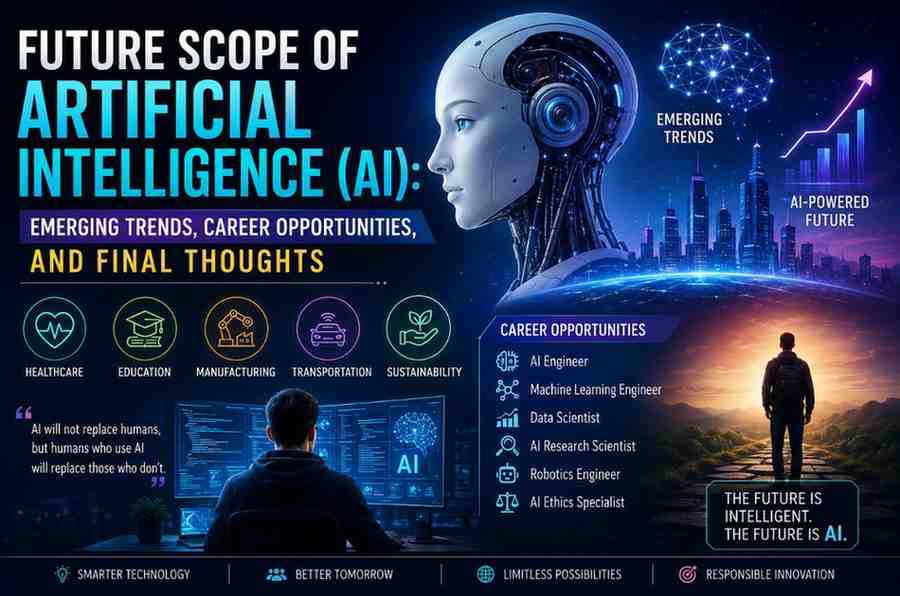
🚀 Part 8: Future Scope and Final Thoughts on Artificial Intelligence
Artificial Intelligence (AI) has already transformed the way we live, work, learn, and communicate. From virtual assistants and recommendation systems to advanced healthcare technologies and self-driving vehicles, AI is becoming an integral part of modern society. However, what we have witnessed so far may only be the beginning.
As technology continues to evolve, AI is expected to become even more powerful, intelligent, and deeply integrated into everyday life. Experts around the world believe that AI will play a central role in solving some of humanity’s greatest challenges while creating new opportunities across industries and professions.
In this final chapter of our introductory AI series, we will explore the future scope of Artificial Intelligence, emerging trends, career opportunities, global impacts, and the responsibilities that come with building an AI-driven future.
1️⃣ Understanding the Future Scope of AI
The future scope of AI refers to the potential areas where Artificial Intelligence can create value, innovation, and transformation.
Unlike many technologies that serve a specific purpose, AI is a foundational technology. This means it can be applied across almost every industry and field of human activity.
Future advancements in AI are expected to influence:
- Education
- Healthcare
- Business
- Agriculture
- Transportation
- Manufacturing
- Scientific Research
- Environmental Protection
- Public Administration
As AI capabilities continue to improve, its impact on society is likely to become even more significant.
2️⃣ The Rise of Intelligent Automation
One of the most important future trends in AI is intelligent automation.
Today, many repetitive tasks are already automated. In the future, AI systems will be capable of handling increasingly complex responsibilities.
Examples
- Smart factories managing production independently
- Automated customer service systems
- Intelligent logistics and supply chains
- AI-assisted financial planning
Expected Benefits
- Increased efficiency
- Reduced operational costs
- Higher productivity
- Faster service delivery
Organizations that successfully integrate intelligent automation will gain a major competitive advantage.
3️⃣ AI and the Future of Education
Education is expected to undergo a major transformation through AI-powered learning systems.
Future AI tools may provide:
Personalized Learning
Every student learns differently. AI can analyze learning patterns and create customized educational experiences.
Intelligent Tutors
Virtual tutors may provide instant support and guidance at any time.
Skill-Based Learning
AI could help identify future career opportunities and recommend appropriate learning paths.
Benefits
- Greater accessibility
- Improved learning outcomes
- Reduced educational inequality
The classroom of the future may combine human teachers with intelligent AI assistants to create more effective learning environments.
4️⃣ AI and the Future of Healthcare
Healthcare is likely to be one of the biggest beneficiaries of AI advancements.
Future AI systems may:
- Predict diseases before symptoms appear
- Develop personalized treatment plans
- Assist in complex surgeries
- Accelerate medical research
- Improve healthcare access in remote regions
Potential Impact
Doctors may use AI as a powerful decision-support tool rather than a replacement.
The combination of human expertise and AI analysis could significantly improve patient outcomes and reduce healthcare costs.
5️⃣ AI and the Future of Work
One of the most discussed topics regarding AI is its impact on employment.
Many routine and repetitive jobs may become automated, while new roles will emerge.
Future Career Opportunities
- AI Engineer
- Machine Learning Specialist
- Data Scientist
- AI Ethics Consultant
- Robotics Engineer
- AI Product Manager
- Prompt Engineer
- AI Research Scientist
Essential Future Skills
- Critical Thinking
- Creativity
- Problem Solving
- Emotional Intelligence
- Digital Literacy
- Adaptability
The future workforce will need to work alongside AI rather than compete against it.
6️⃣ AI and Smart Cities
Future cities are expected to become more intelligent through AI-powered systems.
Applications
- Smart traffic management
- Energy optimization
- Public safety systems
- Waste management
- Environmental monitoring
Benefits
- Reduced pollution
- Better resource utilization
- Improved quality of life
- Enhanced urban planning
AI can help governments create safer, cleaner, and more efficient cities.
7️⃣ AI and Environmental Sustainability
Climate change and environmental challenges require innovative solutions.
AI can support sustainability efforts by:
- Monitoring environmental changes
- Predicting natural disasters
- Optimizing energy consumption
- Improving renewable energy systems
- Supporting conservation projects
Future Possibilities
AI-powered systems may help reduce carbon emissions and support global sustainability goals.
Technology can become a powerful ally in protecting the planet for future generations.
8️⃣ AI and Scientific Discovery
Scientific research often involves analyzing enormous amounts of information.
Future AI systems may accelerate discoveries in fields such as:
- Medicine
- Physics
- Astronomy
- Genetics
- Materials Science
Example
AI may help researchers discover new medicines, identify genetic patterns, and analyze data from deep-space missions much faster than traditional methods.
This could lead to breakthroughs that improve human life on a global scale.
9️⃣ The Emergence of Generative AI
Generative AI represents one of the most exciting developments in Artificial Intelligence.
Unlike traditional AI systems that analyze information, generative AI can create:
- Text
- Images
- Videos
- Music
- Software code
Future Impact
Generative AI may become a valuable tool for:
- Writers
- Teachers
- Designers
- Entrepreneurs
- Researchers
It has the potential to enhance human creativity rather than replace it.
🔟 Artificial General Intelligence (AGI)
Today’s AI systems are specialized and designed for specific tasks.
However, researchers are exploring the possibility of Artificial General Intelligence (AGI).
What is AGI?
AGI refers to a machine capable of understanding, learning, and performing any intellectual task that a human can perform.
Potential Benefits
- Solving complex global problems
- Accelerating scientific breakthroughs
- Enhancing productivity
Challenges
- Ethical concerns
- Safety considerations
- Governance and control
Although AGI remains a future possibility, it is one of the most important topics in AI research.
1️⃣1️⃣ The Importance of Responsible AI
As AI becomes more powerful, responsibility becomes more important.
Future AI systems should be:
Ethical
Respecting human rights and values.
Transparent
Providing understandable explanations for decisions.
Fair
Avoiding discrimination and bias.
Secure
Protecting users from misuse and cyber threats.
Responsible AI development will determine whether AI becomes a force for positive change or a source of new challenges.
1️⃣2️⃣ The Human Role in an AI-Powered World
Despite rapid technological progress, humans remain at the center of innovation.
AI can process information and identify patterns, but humans contribute:
- Creativity
- Empathy
- Ethics
- Leadership
- Vision
The future is not about machines replacing humans.
Instead, it is about creating partnerships where human intelligence and artificial intelligence complement each other.
The most successful societies will be those that combine technological advancement with human values.
🌍 Global Impact of AI
The influence of AI will extend beyond individual organizations and countries.
AI may help address global challenges such as:
- Poverty
- Disease
- Climate change
- Food security
- Education accessibility
International cooperation will be essential to ensure that AI benefits all of humanity rather than a small group of individuals or organizations.
📚 Key Lessons from This AI Series
Throughout this introductory AI journey, we have learned that:
AI is More Than Technology
It is a transformative force shaping modern civilization.
Data Powers AI
Quality data is essential for intelligent systems.
AI Creates Opportunities
New careers, industries, and innovations continue to emerge.
Challenges Must Be Addressed
Ethics, privacy, fairness, and security remain critical concerns.
Humans and AI Must Work Together
The greatest potential lies in collaboration rather than competition.
🎯 Final Thoughts
Artificial Intelligence is one of the most significant innovations in human history. It has already transformed industries, improved lives, and created opportunities that previous generations could only imagine.
Yet the story of AI is far from complete.
The future will bring new breakthroughs, new challenges, and new possibilities. Students, professionals, entrepreneurs, educators, and policymakers all have a role to play in shaping how AI develops and impacts society.
The question is no longer whether AI will influence our future.
The real question is:
How will we use AI to build a smarter, fairer, and more prosperous world?
The answer depends not only on technology but also on the choices humanity makes in the years ahead.
🌟 Conclusion of the Introduction to AI Series
Congratulations! You have completed the 8-Part Introduction to Artificial Intelligence Series.
You now understand:
✅ What AI is
✅ How AI works
✅ The history and evolution of AI
✅ Major milestones and pioneers
✅ AI’s importance in modern life
✅ Real-world applications of AI
✅ Benefits and challenges of AI
✅ Future opportunities and possibilities
This foundation prepares you for the next stage of learning, where we will explore deeper topics such as:
👉 Branches of Artificial Intelligence
- Machine Learning
- Deep Learning
- Natural Language Processing (NLP)
- Computer Vision
- Robotics
- Expert Systems
- Generative AI
Because understanding AI is no longer optional—it is becoming an essential skill for the future.